
Would you rather prevent a problem or merely handle it?
July 2026
This is the third in a series of quarterly articles to help homeowners with things you can do yourself now that can avoid expensive repair work later.
As a local family company, ABV Contractors wants to be your resource when you need us and your source for expertise and advice when you don’t. The article below is one way we can help by sharing simple insights.
Every day, homeowners have to make this decision: Will they act early with basement waterproofing methods — and be proactive? Or wait until they need to act — and be reactive — after water has invaded their home? It’s not as easy a choice as it might seem. The proactive measure requires a greater investment in time and money, while a reactive strategy seemingly saves money. We say “seemingly” because once a problem is discovered, costly damage may have already occurred.
Angi (formerly Angi’s List) deems exterior basement waterproofing methods preventative, in contrast to interior basement waterproofing methods, which they call reactive. The difference is keeping the water and moisture away from the foundation in the first place.
That’s why This Old House calls exterior basement waterproofing methods “the first line of defense against basement moisture issues.” Some experts are more blunt and state that interior methods aren’t waterproofing, but water management — a distinction between superior and superficial.
The foundation of prevention.
At ABV Contractors, we prefer to be more diplomatic and consider both exterior and interior basement waterproofing methods to both have value. In fact, there are instances in which interior work is more appropriate, such as when access to the exterior of the foundation is not practical. When homeowners have a deck or patio that would be too difficult to remove, the cost would become extreme. Somewhere along the way during your homeownership, you may need both exterior and interior methods, even in combination.
The unfortunate reality is that most basements will leak at some point, especially in the Greater Cleveland area where we get hit with plenty of snow and rainfall. As explained by Angi, this is why they’ll most benefit from waterproofing your basement. You want to protect against structural damage, mold growth, and poor indoor air quality. That is best done through exterior basement waterproofing methods. As This Old House points out, most basement leaks originate outside the house. Keeping water and moisture out is essential.
Preventative measures beat reactive ones such as an interior sealant, which is usually not enough on its own because it doesn’t address underlying problems. It can sometimes even trap water in the foundation walls to create problems rather than solve them.
Both Angi and This Old House emphasize that sophisticated basement waterproofing methods are best left to professionals (such as ABV Contractors). As This Old House puts it, “Understanding when to call in the experts can save you time, money, and headaches.” They recommend doing so when you have severe water intrusion or flooding; extensive foundation cracks; or the need to add French drains, exterior waterproofing systems, or sump pump systems.
You can help by looking for some of the signs of a serious issue:
CLOGS — in gutters and drains
CRACKS — found in basement walls, floors, or windows
LEAKS — from interior plumbing or moisture from basement bathrooms, kitchens, or exercise areas
DETERIORATION — of sewer or main water lines
POOLING — on basement floors or against the exterior foundation
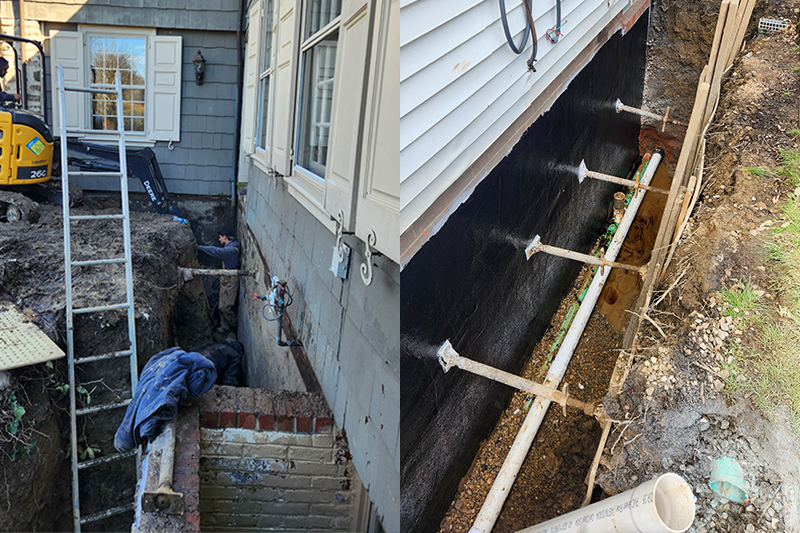
The professionals at ABV Contractors are ready to examine any symptoms that may indicate a need for preventative measures. Some of the most common exterior basement waterproofing methods we implement include French drains to collect shallow runoff and move it away from your home’s foundation; collecting and removing deep runoff and groundwater through footing drains; proper soil gradation so that runoff moves away from the foundation; and a gutter system to keep excess runoff from collecting against your foundation.
As you can see, the home’s foundation is the key to proactive methodologies. This makes sense, because the aim is to keep water and moisture away from the foundation to protect its integrity. Being proactive means it’s best to act sooner rather than later, preventing costly and serious damage from starting.
Call us at 440-951-9420, and we’ll arrange a convenient time to examine your home, its foundation, and your yard. ABV Contractors Co. is the Greater Cleveland area expert in protecting your home’s structural integrity and solving sewage system issues. We’ll inspect, analyze, recommend, and implement what you need and only what you need.